11 Mar
Surfactants Used in Textile Auxiliaries for Knit Dyeing
Learn how surfactants work in textile auxiliaries, their types, and their role in improving dyeing efficiency in knit fabric processing.
Surfactants Used in Textile Auxiliaries
Surfactants form the foundation of many textile auxiliaries used in dyeing and wet processing. These chemicals control surface tension between liquid and solid phases during textile treatment.
In knit dyeing operations, surfactants improve wetting, cleaning, dispersion, emulsification, and dye penetration. Textile engineers rely on carefully selected surfactants to ensure efficient interaction between water, dyes, chemicals, and textile fibers.
Proper surfactant selection improves dyeing stability, fabric cleanliness, and overall process efficiency.
What Are Surfactants
Surfactants represent surface active molecules with two structural parts.
One part attracts water. The other part attracts oil or hydrophobic substances.
This dual structure allows surfactants to position themselves at the interface between water and contaminants. As a result, surfactants reduce surface tension and improve liquid penetration into textile materials.
This property makes surfactants essential for textile wet processing.
Role of Surfactants in Textile Dyeing
Surfactants perform several critical functions during textile dyeing processes.
Major roles include
Reduction of surface tension in water
Improved fabric wetting
Removal of oils and impurities
Stabilization of dye dispersions
Uniform chemical distribution inside dye bath
These functions improve chemical interaction with textile fibers.
Types of Surfactants Used in Textile Auxiliaries
Textile engineers classify surfactants based on the electrical charge of the molecule in water.
Anionic Surfactants
Anionic surfactants carry a negative electrical charge in aqueous solutions.
Common applications include
Detergents in scouring processes
Wetting agents in dyeing
Emulsifiers for oil removal
These surfactants provide strong cleaning efficiency.
Nonionic Surfactants
Nonionic surfactants contain no electrical charge in water. These surfactants remain stable across a wide pH range and high temperatures.
Applications include
Wetting agents for dyeing processes
Emulsifiers in textile auxiliaries
Dispersing agents for dyes
Nonionic surfactants show strong compatibility with many textile chemicals.
Cationic Surfactants
Cationic surfactants carry a positive charge in aqueous solutions. These surfactants strongly interact with negatively charged textile fibers.
Applications include
Fabric softeners
Dye fixing agents
Antistatic treatments
These surfactants improve fabric handle and dye fixation.
Amphoteric Surfactants
Amphoteric surfactants contain both positive and negative charge groups depending on pH conditions.
Applications include
Mild detergents
Specialty textile auxiliaries
Fiber protection during processing
These surfactants offer balanced chemical behavior.
Importance in Knit Dyeing Operations
Knit fabrics contain loop structures that trap air and impurities. Without surfactants, water penetration remains limited and dye absorption becomes uneven.
Surfactants assist knit dyeing processes by
Removing air from fabric loops
Allowing uniform water penetration
Supporting even dye distribution
Improving dye uptake efficiency
These improvements reduce dyeing defects.
Surfactants in Different Textile Auxiliaries
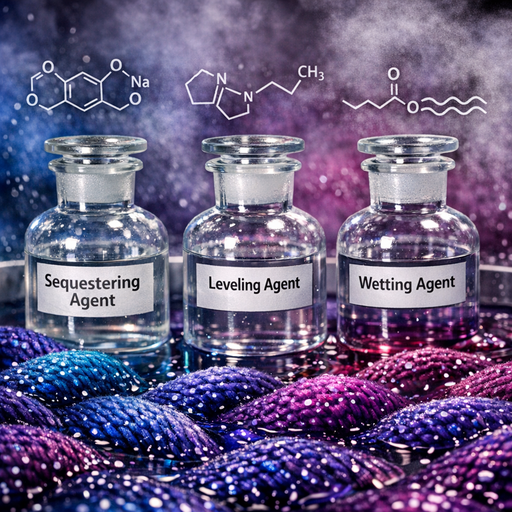
Many textile auxiliaries contain surfactants as their active components.
Examples include
Wetting agents
Detergents
Dispersing agents
Leveling agents
Soaping agents
Each formulation uses specific surfactant structures to achieve targeted process functions.
Engineering Considerations for Surfactant Selection
Textile engineers evaluate several factors when selecting surfactants for dyeing processes.
Key considerations include
Compatibility with dyes and auxiliaries
Stability under high temperature conditions
Foam generation tendency
Biodegradability and environmental compliance
Proper selection ensures reliable dyeing performance and regulatory compliance.
Benefits for Textile Dyeing Mills
Efficient surfactant systems improve dyeing performance and operational efficiency.
Major advantages include
Improved fabric wetting and cleaning
Stable dye bath performance
Higher dye penetration efficiency
Reduced processing defects
Improved dyeing reproducibility
These benefits contribute to consistent textile production.
Conclusion
Surfactants play a central role in textile auxiliaries used during dyeing and wet processing operations. Their ability to reduce surface tension and improve chemical interaction with textile fibers supports efficient dyeing performance.
Textile engineers rely on different surfactant types including anionic, nonionic, cationic, and amphoteric surfactants to achieve specific processing objectives in knit dyeing mills.
Proper surfactant selection ensures stable dyeing processes, improved fabric quality, and efficient chemical utilization.