06 Apr
Wetting Agent for Desizing and Scouring in Woven Fabric
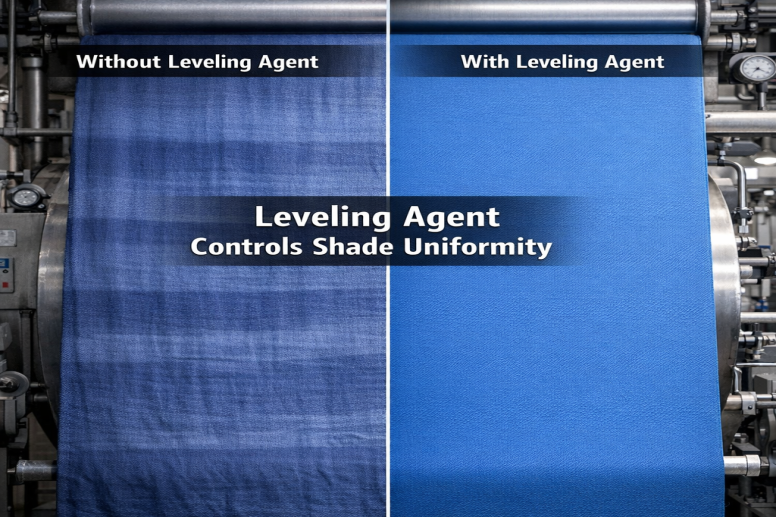
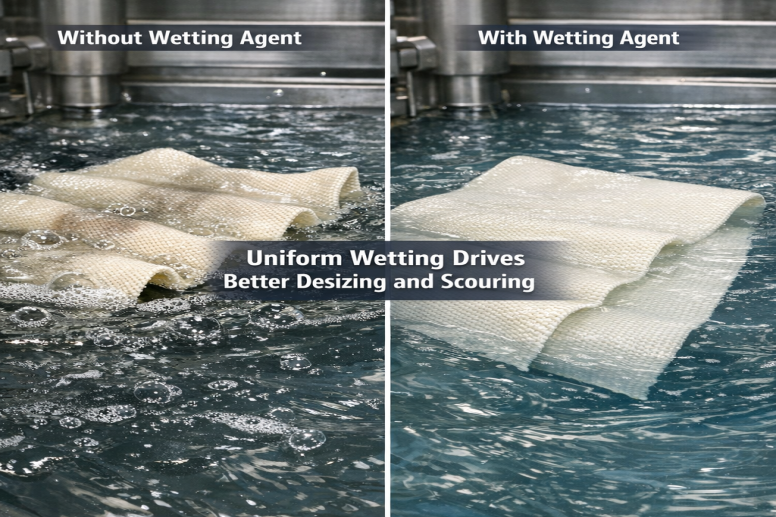
Wetting agents control how fast and how uniformly water penetrates woven fabric. In desizing and scouring, fast and even wetting removes size, oils, waxes, and dirt. Poor wetting leaves patches, causes uneven absorbency, and leads to shade variation in later dyeing.
What is a Wetting Agent?
A wetting agent is a surfactant that lowers surface tension of water. This helps the bath enter yarn interstices quickly and uniformly.
Key functions:
Rapid fabric wet-out
Uniform liquor penetration
Better removal of size and impurities
Improved absorbency for downstream processes
Why Wetting Matters in Woven Fabric
Woven structures are tighter than knits. Air trapped in yarn bundles slows liquor entry.
If wetting is poor:
Incomplete desizing
Residual size blocks scouring chemicals
Uneven absorbency across width and length
Patchy dyeing and reprocessing cost
Types of Wetting Agents Used
Choose based on process conditions and fabric composition.
Anionic wetting agents
Strong detergency
Good for scouring with alkali
Nonionic wetting agents
Stable over wide pH range
Good compatibility with enzymes and auxiliaries
Low-foam wetting agents
Preferred in jet and overflow machines
Maintain circulation and levelness
Selection Criteria
Use a simple checklist before finalizing a product:
Wetting speed
Fast drop test and sink timeCompatibility
With enzymes in desizing and with caustic in scouringFoam profile
Low foam for high turbulence machinesTemperature stability
Effective from ambient to 95–100°CElectrolyte tolerance
Stable in presence of salts and hardnessBiodegradability
Meets compliance requirements
Application in Desizing
For starch or modified starch sizes:
Add wetting agent at the start of the bath
Ensure quick penetration before enzyme action
Maintain uniform pick-up across the fabric
Typical guide:
Wetting agent: 0.5–1.5 g/L
Enzyme: as per supplier
pH: 5.5–7 for enzyme efficiency
Temperature: 55–65°C
Result:
Faster size breakdown
Cleaner fabric surface
Consistent absorbency
Application in Scouring
For removal of natural and added impurities:
Dose wetting agent with alkali and sequestering agent
Keep liquor well circulated
Typical guide:
Wetting agent: 0.5–2.0 g/L
NaOH: as per fabric requirement
Sequestering agent: 0.5–1.0 g/L
Temperature: 90–100°C
Result:
Better oil and wax removal
Uniform hydrophilicity
Stable base for bleaching and dyeing
Common Problems and Fixes
Problem: Fabric floats, slow wet-out
Increase wetting agent dosage
Check foam and circulation
Problem: Uneven absorbency (drop test variation)
Improve pre-wetting stage
Use a faster wetting grade
Problem: Residual size after desizing
Confirm compatibility with enzyme
Extend dwell time after proper wetting
Simple Tests to Validate Performance
Drop test: water drop should spread quickly
Sink test: fabric sinks within seconds
Wicking test: measure vertical rise for uniformity
Residual size test: iodine test for starch presence
Practical Takeaway
Start with wetting, not with higher chemistry load
Match the wetting agent to machine type and process conditions
Control dosage based on fabric GSM and construction
If your woven fabric shows uneven absorbency or desizing issues, share your process details. We can review and solve the problem with a practical approach.