07 Apr
Leveling Agent for Reactive and Vat Dyeing in Woven Fabric
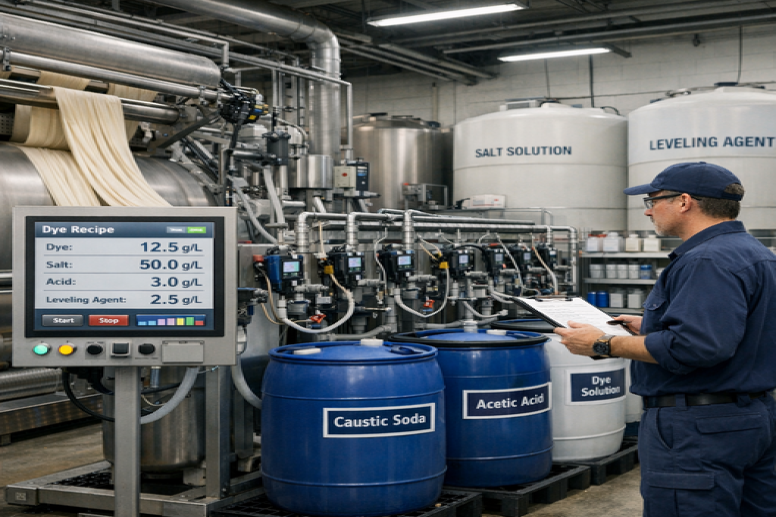
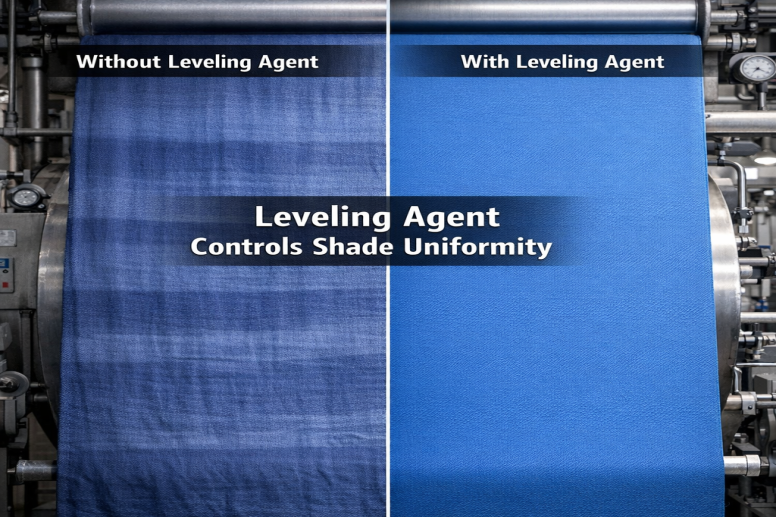
Leveling agents control dye migration and adsorption. In woven dyeing, they help achieve uniform shade across width and length, even on tight constructions and high GSM fabrics.
What is a Leveling Agent?
A leveling agent is a dyeing auxiliary that balances dye uptake. It slows initial strike, promotes migration, and evens out concentration differences during the process.
Core functions:
Controls dye exhaustion rate
Improves migration and redistribution
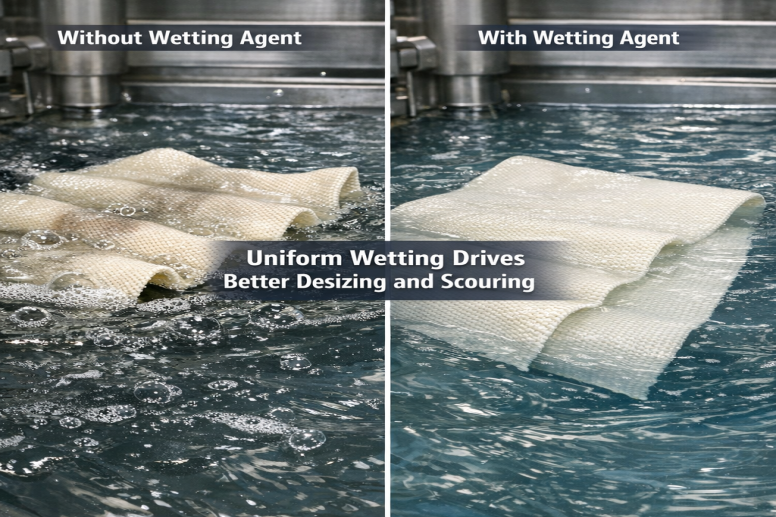
Prevents streaks, patches, and barre
Enhances shade uniformity
Why Leveling is Critical in Woven Dyeing
Woven fabrics show higher risk of unevenness due to:
Tight weave and variable pick density
Beam or rope variations
Temperature and flow differences in machines
Without proper leveling:
Fast dye strike on outer layers
Uneven penetration into yarn core
Visible streaks and shade bands
Re-dyeing and cost increase
Leveling in Reactive Dyeing
Reactive dyes form covalent bonds with cellulose. Uncontrolled conditions lead to rapid fixation and poor migration.
Challenges:
High initial affinity
Electrolyte-driven fast exhaustion
Early fixation reduces leveling window
How leveling agents help:
Reduce dye affinity at start
Delay strike to allow uniform penetration
Support migration before fixation
Application guide:
Leveling agent: 0.5–1.5 g/L
Add before dye and salt
Control salt addition in steps
Maintain pH and temperature ramp
Result:
Even shade build-up
Reduced streaks and side-to-center variation
Leveling in Vat Dyeing
Vat dyes require reduction, absorption, then oxidation. Uneven reduction or oxidation creates patchiness.
Challenges:
Insoluble dye needs proper dispersion
Uneven leuco form penetration
Oxidation differences across fabric
How leveling agents help:
Improve dispersion of reduced dye
Promote uniform penetration in leuco state
Support even re-oxidation
Application guide:
Leveling agent: 0.5–2.0 g/L
Use with dispersing and wetting agents
Maintain stable reduction potential
Ensure controlled oxidation step
Result:
Clean, level shades
Better depth and consistency
Types of Leveling Agents
Anionic leveling agents
Good for reactive systems
Reduce dye-fiber attraction early
Nonionic leveling agents
Broad compatibility
Stable across pH and temperature
Cationic leveling agents
Used selectively for specific dyes
Strong interaction with anionic dyes
Selection Checklist
Dye class compatibility (reactive or vat)
Migration performance at process temperature
Electrolyte and alkali stability
Low foam behavior in jet or soft flow machines
Impact on shade depth and fastness
Common Problems and Fixes
Problem: Side-to-center shade variation
Improve liquor flow and add leveling agent early
Control salt addition rate
Problem: Streaks or rope marks
Increase leveling dosage within limits
Optimize temperature ramp
Problem: Poor shade depth
Reduce overuse of leveling agent
Balance with exhaustion and fixation steps
Simple Tests to Validate Leveling
Visual shade uniformity check across width
Spectrophotometer reading (ΔE) at multiple points
Cross-section dye penetration test
Reproducibility check batch to batch
Practical Takeaway
Control dye strike first, then fixation
Add leveling agent before critical additions
Balance leveling with productivity and shade depth
If you face uneven dyeing in woven fabrics, share your process details. We can discuss together and solve the issue with a practical approach.